Showing posts with label Mormon. Show all posts

Saturday, June 17, 2017

Saved From What?

We live in a world that is quite accommodating when it comes to making mistakes. By and large, that is a good thing. We ought to forgive one another and have second chances. But I have realized that a world with such leniency has altered my perception of God's eternal laws of justice and mercy.


For example, I remember the first time I overdrafted my checking account. I was a teenager and had simply forgotten to check how much was in my account before making a purchase. A $35 overdraft fee was charged to my account (that even seems like a lot today, but it was monumental to a 17 year old). I felt horrible for letting my negligence lead to such a financial loss. I discussed it with my mom, who suggested I call the bank. She felt confident that, because this was my first offense and it was truly an accident, they would be willing to waive the fee.
I was skeptical. After all, this was my fault, and the fee was something I had agreed to in the contract I signed.
But I made the call, trying to sound confident because my mom was sure it would work. And I was shocked as the bank employee quickly removed the fee.

This line of thinking - I realized - was carrying over into my thoughts of spiritual justice and mercy. My experience with the bank decreased my fear of future overdrafts. I felt that their punishment was really just an empty threat.

I have found myself propagating this notion in my own children when I say things like, "if you get in your car seat right now, you can have a popsicle at home," but I give them a popsicle whether or not they comply with their part of the bargain.


If we are not careful, it is easy to believe that things would have worked out whether or not Christ had come. We may be deceived into thinking that His punishment for sin is just an "empty threat," or, as one Book of Mormon writer said, "eat, drink and be merry... and God will beat us with a few stripes.." (2 Nephi 28:8) I had a Seminary teacher who referred to this as being whipped with wet noodles.

Such a thought process may lead us to think that repentance is not truly important, and to under appreciate what Jesus Christ's life and mission truly accomplished.

So what did Christ really save us from?

"Wherefore, all mankind were in a lost and in a fallen state, and ever would be save they should rely on this Redeemer." (1 Nephi 10:6)

.........................
"And thus we see that all mankind were fallen, and they were in the grasp of ... the justice of God, which consigned them forever to be cut off from his presence... therefore, God himself atoneth for the sins of the world..." (Alma 42:14-15)

.........................
"Jesus saith unto him, I am the way, the truth, and the life: no man cometh unto the Father, but by me." (John 14:6)

.........................
"O the wisdom of God, his mercy and grace! For behold, if the flesh should rise no more our spirits must become subject to ... the devil, to rise no more. And our spirits must have become like unto him, and we become devils, angels to a devil, to be shut out from the presence of our God, and to remain with the father of lies..." (2 Nephi 9:8-9)
.........................


The consequences are real. That last verse sends shivers down my spine. These inspired verses together - and so many others - give me a true understanding of what Christ has saved me from, and all that He will save me from if I will repent and come unto Him.

He is real. He is my Savior, and He is yours. He redeemed us at the highest possible price - His own blood. I am eternally grateful to Him.

Saturday, April 15, 2017

Lehi and Christ

In my study of the Book of Mormon, I came across this verse in 1 Nephi chapter 19:

"And behold [Christ] cometh, according to the words of the angel, in six hundred years from the time my father left Jerusalem."


 As I pondered why this event - Lehi leaving Jerusalem - was chosen as the reference for this most important event, I remembered another Book of Mormon scripture, and started looking for symbolism:

"all things which have been given of God from the beginning of the world, unto man, are the typifying of [Christ]."

My thoughts are only that - thoughts. I hope they will generate more thoughts of your own and invite you to share other connections you make.


Thoughts

Leaving all behind

How might Lehi be a type of Christ? And more specifically, how might Lehi's leaving Jerusalem be symbolic of Christ being born?

There is great richness in this verse when considering this question:

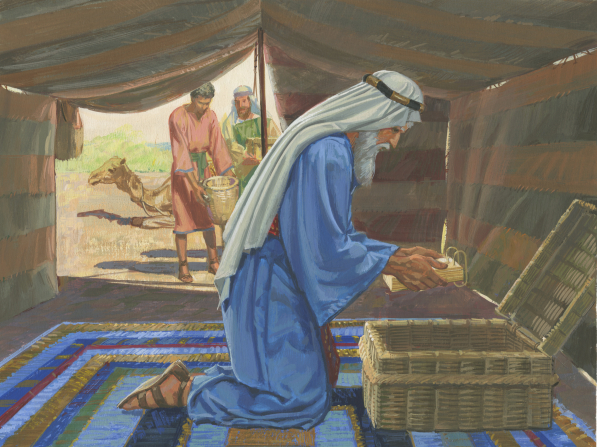
"And it came to pass that he departed into the wilderness. And he left his house, and the land of his inheritance, and his gold, and his silver, and his precious things, and took nothing with him, save it were his family, and provisions, and tents, and departed into the wilderness."

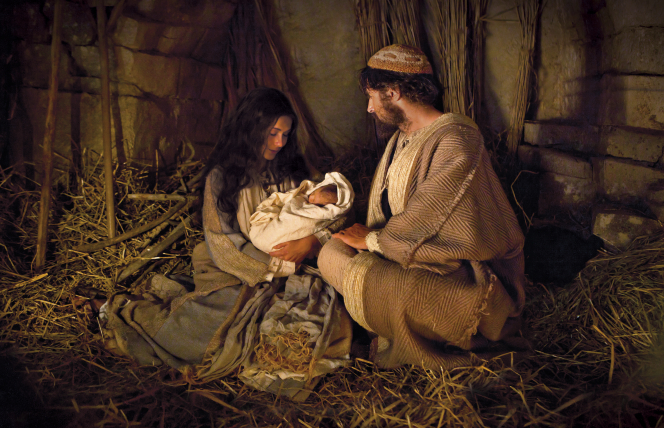
When Christ was born, He left His Father's glorious kingdom to be born in a lowly manger. He condescended and - though a God - was born as a helpless infant. He left royal courts above to sojourn here on earth, similar to how Lehi left all in the Holy City and wandered into the wilderness.


Journey to the Promised Land

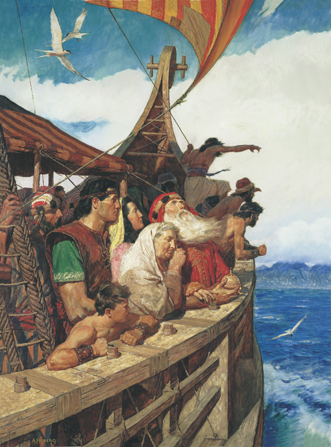
After many years of wandering in the desert, Lehi and his family built a boat and sailed to the Promised Land. As they heeded his prophetic counsel, his family was guided through the trials of a scorched desert and a restless sea, through hunger and heartache, until they arrived in the promised land.


In a similar - yet much greater - way, our Savior left His Home above to be our guide through the heat of the desert and the waves of the sea, that He might guide us to our Promised Land. We will suffer just as Lehi's family did, but we can have the assurance that our guide - Jesus Christ - will support us in every trial as we rely on Him (see Alma 36:3).


A Stumbling Block

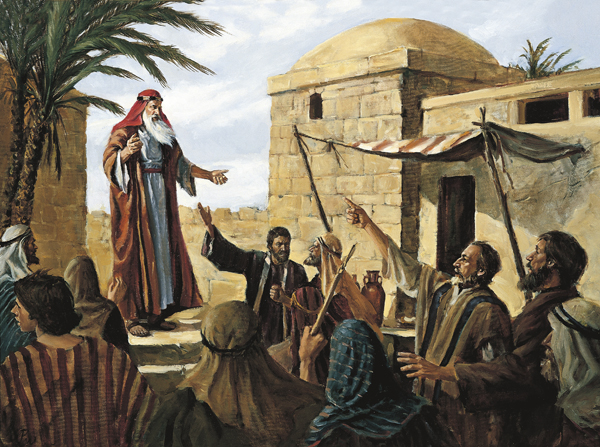
One final parallel that I found between Lehi and Christ is that neither one had a perfectly "loyal" following - even among their very closest associates. Lehi was commanded to flee Jerusalem because the people were angry with him for speaking the words that God delivered to him, and sought to take his life.


His own sons, Laman and Lemuel, constantly complained and questioned his authority and leadership. On more than one occasion they plotted how they might kill their foolish, visionary father and their brother Nephi.

Christ, of course, was betrayed by one of His Apostles. He was rejected by the chief priest and the Sanhedrin in general.


 On the day of His crucifixion, the crowds cried for his death. His own Apostles left Him:
"Behold, the hour cometh, yea, is now come, that ye shall be scattered, every man to his own, and shall leave me alone: and yet I am not alone, because the Father is with me."
After the thousands who were fed in the wilderness turned and "followed Him no more", the Savior asked His chief Apostle, "Will ye also go away?" (see John 6:66-69).
Peter proved faithful in the end, but even he denied the Savior on the eve of His death.


Conclusion

The scriptures truly point us to Christ. I am convinced that one day, the Lord will explain the scriptures to us as He did to the Nephite multitude, and we will be amazed at how many symbols and types of Christ were right before our eyes all along. He is our Savior. I am so grateful that He left all and descended below all things, that He might lift us above all things and guide us safely home to the Promised Land.


These thoughts are my own personal thoughts and do not represent in any way the official position of The Church of Jesus Christ of Latter-Day Saints.

Sunday, December 6, 2015

Why did the destroying angel pass by?

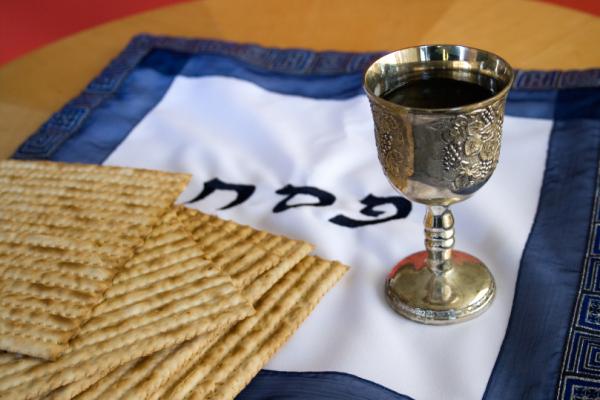
Each Sunday, I have the privilege to partake of the sacred emblems of the Sacrament representing the body and blood of Christ, and to ponder that magnificent sacrifice. This week, my thoughts turned to Passover and the promise of a Messiah.

I thought of the circumstances of the first Passover, when the Lord commanded His people to kill a lamb and paint their doorpost with its blood.
The destroying angel came that night, and passed by the homes with the lamb's blood on the door. In the homes without blood on the door, the first born son's life was taken.

This story is so rich with imagery and symbolism. Of the many things I could focus on, I want to discuss just one - why did the destroying angel pass by those homes?

It was the blood.

It was not the righteousness of the family who lived inside. It was not how hard they worked or how nice they were to their neighbor. It was not how forgiving they were.

It was the blood of the lamb.

God commands us to be righteous, to work hard, to forgive, etc. He asks us to keep His commandments.
And we cannot be saved without it, just as the Israelites could not be saved without obeying the Prophet's command to put the lamb's blood on their door.

Temporal salvation for the Israelites merely required applying the lamb's blood to their door; eternal salvation for all of us requires more - we must apply the Lamb's blood into our lives! We must use His Atonement to repent, overcome our weaknesses, and become like Him.
To accept Him and apply His blood means more than lip service - as Paul said, we must write His law "in the fleshy tables of the heart" (2 Corinthians 3:3).

But ultimately, it is the blood of the Lamb that makes us acceptable before God.

In a prophecy given through Joseph Smith, the Lord described the Final Judgement, where He will act as our advocate with the Father. Notice the "evidence" that the Lord gives in support for our being saved:


"Father, behold the sufferings and death of him who did no sin, in whom thou wast well pleased; behold the blood of thy Son which was shed, the blood of him whom thou gavest that thyself might be glorified;
 Wherefore, Father, spare these my brethren that believe on my name, that they may come unto me and have everlasting life."

The Lord is our advocate, and it is through His blood that we are saved, but we must cover our lives with His blood as the Israelites covered their door in order to be saved. 

I am so grateful to Jesus Christ for descending from His Throne above to rescue me. He paid the highest price imaginable to redeem my soul - the blood of the Lamb of God.

Sunday, December 7, 2014

A Life More Abundant

After 20 minutes in a small bus jammed to overflowing with passengers, I tapped the man who had taken my 20-cent fare and told him this is where we got off. I was tall by Central American standards, and squeezing past everyone took a little bit of time. 

Once the bus came to a stop and I got my feet on pavement, I could stretch out and breathe. My missionary companion exited behind me, and we began the walk down the dirt path to visit Vicenta Rodriguez.

Vicenta was 25 years old and lived with her brother, Neftali, and her elderly mother. Her other brothers frequented the house, but were involved in the pandilla - the gang- and we never met them. As we sat and talked with her, we asked her how job at the warehouse was going. She told us about her long hours and said that, despite the fact that the pay was low, she was grateful to have a job when so many others did not.
I asked her how much she made a week, and quickly calculated that she was paid less than 50 cents an hour for her work.

50 cents an hour! 

And I thought my $8 an hour job was low paying! I couldn't believe it.

I met many people during my 2 years in El Salvador who lived in depths of poverty that were beyond my imagination. Many in our world today - poor or rich - have opportunity to ponder this profound question: 

What is the purpose of this life anyway?

Why are we here? To be born, to work ourselves to death, to suffer hardships and sorrow, and then to die?


During this past week, I was deeply touched by these moving words from the Savior of Mankind, Jesus Christ:

"I am come that they might have life, and that they might have it more abundantly."
John 10:10

As we follow our Savior Jesus Christ, our life becomes abundant. It becomes more than a job, more than "one more day". It becomes meaningful.

Following Christ does not mean we will be freed from poverty; In the Old Testament, Job lost all..

Following Christ does not mean we will not suffer; The Apostles counted themselves fortunate to suffer for Christ's sake (Acts 5:41).

But, following Chris does mean that life will be abundant. 

It does mean that, despite our challenges and trials, God will not forsake us (Matthew 28:20).

It does mean that the grace of God may be extended to us to help us carry our burdens (Hebrews 4:16)

Following Christ, and losing our lives as we serve Him, means that we will find our lives and find true joy in living (Matthew 16:25)


Jesus Christ descended below all things so that He can lift us above all things. 

He conquered the world - conquered sin and death - so that He can help us to overcome all things (Doctrine and Covenants 88:6)

"He is the light and the life of the world; yea, a light that is endless, that can never be darkened; yea, and also a life which is endless, that there can be no more death."

He is the Savior of all mankind. May we come to Him, keep His commandments, and experience an abundant life.

Photo credit: Tyler Foote

Sunday, June 15, 2014

The Sweet Truth About Repentance

Jesus Christ died for our sins. This is true. But He did not die so that the wicked could enter heaven. He died so that the wicked may become righteous.

He died so that we (who are ALL sinners) can be freed from the shackles of sin - free to change and grow and improve.

He died so that - with His help - we can cease to be wicked and learn to be righteous.

That change is repentance.
Photo Credit: Tyler Foote


When Jesus Christ died for us on the Cross, he did more than just die for our sins. He suffered for them. He paid for them. Just as there are consequences for crimes in our earthly systems of justice, there are consequences for sin in the heavenly system of justice. Christ paid the price for each and every sin committed by each and every child of God. He took the consequences upon Himself - He served our term in prison, as it were.

He did this so that we may be released from our burden to pay the price and to serve our time in "spiritual prison", if we will repent.

However, modern scripture assures is that if we do not repent, we must suffer, even as Christ suffered, for our sins.

" 16 For behold, I, God, have suffered these things for all, that theymight not suffer if they would repent;
 17 But if they would not repent they must suffer even as I;
 18 Which suffering caused myself, even God, the greatest of all, to tremble because of pain, and to bleed at every pore, and to suffer both body and spirit—and would that I might not drink the bitter cup, and shrink—
 19 Nevertheless, glory be to the Father, and I partook andfinished my preparations unto the children of men."

To repent is more than just to overcome a bad habit. To repent is to be cleansed from our sins, having them washed out by the atoning blood of our Savior and Redeemer.
Once we have repented, the stain is gone. The sin is forgotten. The deed is paid or and put away and never remembered again between us and God.


"Come now, and let us reason together, saith the Lord: though your sins be as scarlet, they shall be as white as snow; though they be red like crimson, they shall be as wool."
~Isaiah 1:18


Photo credit: Christina Foote

Sunday, May 4, 2014

The Good News is...

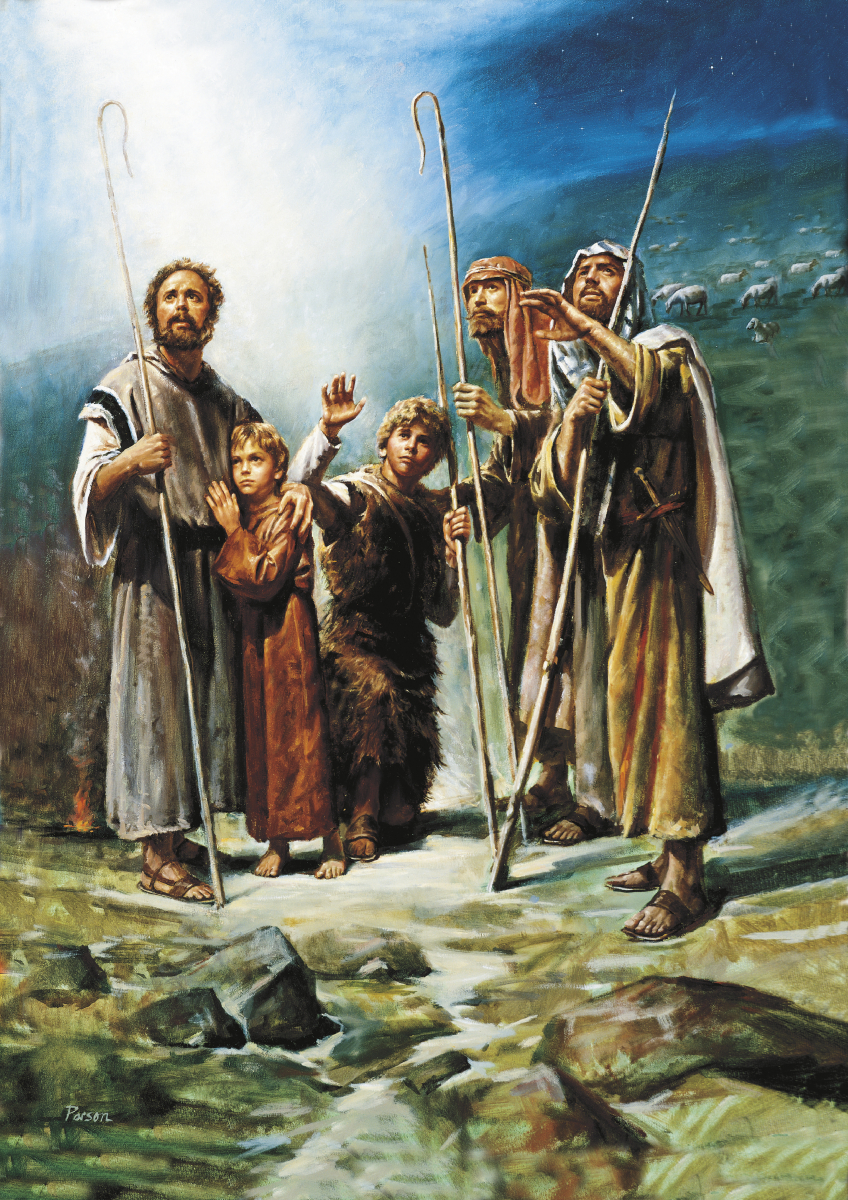
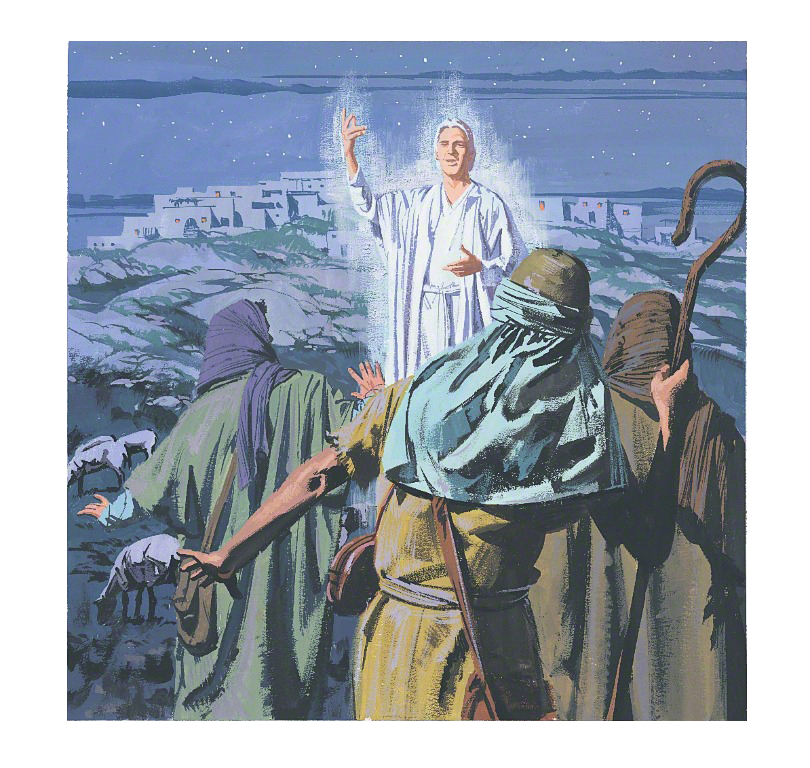
When the angel appeared to the shepherds outside of Bethlehem, he announced good tidings of great joy; he announced the birth of the Savior of mankind.


That singular event - the birth of Jesus Christ - began a life of service and devotion and salvation. Because of Christ and His Atonement, the way has been prepared for us to return to live with our Father in Heaven.
The good news that the angel announced was His Gospel - the Gospel of Jesus Christ.

The Greek account uses the word "evangelizomai", which is translated as "good news"
It is derived from euaggelizo, which can be broken down into

eu and  aggelos


……………….……………….……………….……………….……………….……………….


Eu means good

Aggelos means angels


What are angels?
Messengers for God.

The words of Alma come to mind - "O that I were an angel." His desire is to proclaim the Gospel as if with the trumpet of an angel.

And what is the good thing or good message that these angels announce?
The Gospel of Jesus Christ.

Interestingly enough, euaggelizo is the root of another word we often use.
To evangelize is to preach to or to declare good tidings.
In Spanish, evangelio is translated in place of the English word, gospel.


What is the Gospel?
It is to declare the good message of Christ.

Missionary work is the Gospel.
It literally is the heart of the Gospel. The center. The soul.

Mosiah 18:22
 22 And thus he commanded them to preach. And thus they became the children of God.


Images used from lds.org

Sunday, April 20, 2014

Christ is Not Just a Benevolent Bystander


When the Lord Jesus Christ taught His disciples to pray, He gave them a model to follow. We often refer to it as the Lord's prayer. Many Christians can recite this beautiful prayer from memory. There is much that it can teach us about God and what our communication should be with Him.

As I studied this powerful prayer, I came to a phrase near the end that taught me a powerful lesson about Christ.

"Lead us not into temptation, but deliver us from evil," the Lord said (Matthew 6:13).

The Greek word used for "deliver" is ῥύομαι (rhoumai), which means "to rescue." 
But it means more than that. 
Strong's concordance, a well-known biblical resource, defines rhoumai further as meaning:


"to draw to oneself"

"to snatch up"

"to rescue a person to and for the deliverer"

"to deliver someone to and for the rescuer"


As I read these definitions, I imagined a family outing by a fast-flowing river. I imagined a struggling, drowning child, and an anxious group of onlooking adults unsure of how to save her from the fast-moving water. 
I then imagined a benevolent bystander who happened to be an excellent swimmer diving in and rescuing the child.
He did not know the child. He did not love the child. But he was a good person who wanted to do what was right.

This is a beautiful and noble act, but it is not what the word connotes.

Christ rescues us to Himself.
He is the one who is most concerned for our safety and salvation.
He plunges into the water out of pure love for us. He ignores any danger. He gives His life in order to rescue us.
He is not just a benevolent bystander.
He is our Savior, who saves us to Himself because He loves us more than anyone else.

Sunday, April 13, 2014

Mount Sinai Renewed

Last weekend, I had a marvelous experience. In the midst of my busy semester and busy life, I was able to slow down and have an experience analogous to that of the children of Israel at Mount Sinai.


Just as their prophet, Moses, brought down the word of God and shared it with them, our prophet, Thomas Monson, delivered to us the words that God would have us know.


But not just him.


The Twelve Apostles also addressed the worldwide church, The Church of Jesus Christ of Latter-Day Saints.

These men, just like the 12 Apostles of Christ's ancient Church, are called to preach the Gospel to all the world. They hold the same authority given to Peter, James, John, and all of the ancient Apostles by Christ Himself.

How do Thomas Monson and these Twelve Apostles claim to have that same authority?
How could it be on the earth again?

The writer of Hebrews reminds us that "no man taketh this honor unto himself, but he that is called of God, as was Aaron" (Hebrews 5:4).

Aaron received his authority from Moses, the Prophet.

Who did these men receive their authority from?
In 1829, Joseph Smith was visited by the leading authorities of Christ's ancient Church - Peter, James, and John - and given the authority which they held, in order to renew Christ's Church today.

That authority has been passed down in an unbroken chain of prophets, from Joseph Smith to Thomas Monson.

Mount Sinai is a thing of the past. But Prophets are not! God loves us today. He continues to send His prophets.
The words of God's prophet today, Thomas Monson, and the Twelve Apostles, are available.
Study them.
Ask God if they are truly prophets, for "by their fruits ye shall know them" (Matthew 7:15-16).

Here are their words

And here are a few of my favorite excerpts

"...are you the same person wherever you are and whatever you are doing—the person our Heavenly Father wants you to be and the person you know you should be?"
-Thomas Monson

"As you pray and serve others, your knowledge that you are a child of God and your feelings about Him will grow. You will become more aware that He is saddened if you are dishonest in any way. You will be more determined to keep your word to God and to others."
-Henry Eyring, Apostle

"There are countless ways technology can distract you from what is most important. Follow the adage “Be where you are when you are there.” When you are driving, drive. When you are in class, focus on the lesson. When you are with your friends, give them the gift of your attention. Your brain cannot concentrate on two things at once. Multitasking amounts to quickly shifting your focus from one thing to another. An old proverb says, “If you chase two rabbits, you won’t catch either one.” "
-Randall Ridd, leader of Young Men in the Church
"At times we may be tempted to practice what I call “natural man’s obedience,” in which we disobediently reject God’s law in favor of our wisdom or our desires or even popularity."
Robert Hales, Apostle

"Christlike love is the greatest need we have on this planet"
Jeffery Holland, Apostle

Tuesday, March 25, 2014

The 5 AM Snooze

My Freshman year at college, I went to a beginning guitar class with a friend a few times. The instructor was a HUGE Beatles fan. His curriculum for the class was to play Beatles songs, and only Beatles songs, the entire semester. This brought me to a realization - the Beatles wrote a LOT of songs!

During a pause between "Love Me Do" and "I Want To Hold Your Hand," the instructor made a comment that really impacted me.
"You know," he said, "The Beatles weren't popular right away. They wrote over 100 songs before ONE of them made it to the radio."

What?
I had seen "That Thing You Do." I thought the Beatles were just like The Wonders - their first song was an instant hit.


I once heard a story about a world-class violinist who performed countless masterpieces at a performance in one of the great halls of Europe. At the end of his performance, a well-to-do man who was in the audience approached him.
"You are a prodigy," he told the violinist. "A genius! I would give anything to be able to play like you."

"Me, a prodigy? A genius," the violinist responded, confusion and a bit of disgust in his voice. "You would give anything to play like me, would you? I practice 16 hours every day! I have done so for over a decade."

The other man's face showed his amazement. Perhaps he wouldn't give anything to play like this man.


I wish to share one more story to illustrate the point I hope to make.

I come from a large family, and love every member very much. All have gone on to successful careers, or are still being educated in order to pursue them. One brother graduated as an accountant and secured a job at a major accounting firm soon after graduating. He and his wife and new baby moved out to San Jose, California and began their adventure there. However, the job was not what he had anticipated.

The hours were long, the work was tedious, and he was not happy. He left for work before his daughter was awake and got home after she had gone to bed. He was missing out on the most important parts of life.

So he started waking up at 5 AM.
He had a friend at LinkedIn, and had the dream of applying for a job as a web developer.
He woke up early and studied programming. He had taught himself to program at a low-paying, undergraduate job, but knew he would need more than that.
He got the job.

What is he doing now?

He is, once again, waking up at 5 AM, this time to write a book on programming.
I recently asked him, "must victory always come at such a price?"
His response:
"There is no shortcut to a dream."


Another friend at his accounting firm said, "man, I wish I had the skills you do so I didn't have to work here anymore."
It is more than skills, I think my brother would agree. In fact, his book is based on the concept that anyone can learn how to program.
The violinist might say that anyone can learn to play the violin.
Paul McCartney might tell you that anyone can be a successful musician.

But...
They need to work.
They need to be willing to avoid hitting the snooze button at 5 AM.

As President Thomas S. Monson said, leader of the Church of Jesus Christ of Latter-Day Saints,
"Work will win when wishy-washy wishing won't."

Sunday, February 9, 2014

"Come, And See"

For me, there is perhaps nothing more frustrating than finding myself unable to communicate clearly something that is of importance to me.

As a 19-year-old boy, I left for El Salvador to be a missionary. Upon arriving, I was assigned to work alongside a man from El Salvador who spoke little English. We were together every minute of every day. No one else in my new "life" spoke English. I struggled, not being able to express what was in my heart because of my faltering Spanish.

My Spanish improved, but I found myself faced with the same problem as I tried to explain the Gospel to those I taught.

Just as the Gospel and the Church existed in the days of Christ, they exist today.
Prophets.
Apostles.
Baptism.
Salvation.

Many of them did not understand.

It is hard to describe in words that which is spiritual.

Paul spoke of the peace of God, which passeth all understanding (Philippians 4:7). Words fall short of describing such an intense and incredible feeling of peace.

Christ, the Master teacher, gave what I feel is a perfect solution to this problem. He did not try to explain every minute point of His Gospel with words. Instead He invited, "Come, and see."

And that is my invitation to you.

Come and see.

I believe that the Church of Jesus Christ of Latter-Day Saints is, in every literal sense, the same Church that Jesus Christ organized in the meridian of time.
I believe that He is the head of this Church, which now has over 15 million members around the globe.
He is the head, not Joseph Smith or Brigham Young or Thomas S. Monson.
Jesus Christ leads His Church today by means of these inspired prophets, just as He did in ancient times by means of Moses and Isaiah and Peter.

I cannot adequately express the peace and joy that come to me because of my membership in this Church, so instead of trying to explain it to you, I invite you to -

Come and see.


Sunday, January 5, 2014

The Nature of Deity

This morning, I sought to better understand the nature of God. I made it the focus of my personal study in the word of God. Among other things, I read the words of Joseph Fielding Smith, a modern-day prophet of the Church of Jesus Christ of Latter-Day Saints, found here.

As I read, I developed a statement of what the nature of Deity is to me. I would like to share this now, and invite the reader to carefully consider each point. The basis for this understanding of Deity is the First Vision of the Prophet Joseph Smith in 1820, in which he saw the Father and the Son as two separate and distinct beings (see video below).


Here is my statement of personal belief:


God the Father, Jesus Christ, and the Holy Ghost are three distinct beings. God is our literal and personal Father, who knows us by name. We were literally created in His image. Jesus Christ, His Son, paid the price for our sins so that we can live with God again if we choose to obey God and repent. But, because God has given us agency to choose, He will not force us to follow Him, and if we do not, we will not be saved. God wants all of His children to return to Him and has provided a way for us to be like Him. He sends His servants, prophets, to show us the way and to help us be successful and happy in this life.


Saturday, March 16, 2013

Not Even the Raging Sea

The Savior told His Apostles to get into a boat, and to go across the Sea of Galilee. He told them that He would wait a little while, and meet them later on. And then Christ went up on a hill to pray, while his apostles departed in their ship.


The sea was very rough that day. They toiled and rowed against the "contrary winds" without much success. The record says that the Lord saw them toiling, from His mountaintop (Mark 6:48). 
And in the fourth watch, He went to them, leaving the shore and walking to them across the water. They cried out, being troubled and supposing that they had seen a spirit.
And then the Savior spoke, "Be of good cheer: it is I; be not afraid" (Matthew 14:27). It was the Savior, who, hours earlier, they had seen on the shore as they set out to sea. 

I think that they must have thought of Him, in the midst of this storm, having seen the miracles that He had performed. But I imagine they did not expect the Savior to come unto them. He was on the land, and they were out at sea.

But He came. 

He saw them toiling, and He came unto them. 
There was no barrier that could keep the Lord from coming to His struggling sheep. The raging sea could not stop Him from giving them aid.


There is no place that we, as sheep, can wander, that the Lord our God cannot reach us. We must not think, "I am in the midst of this raging storm. The Lord is on the shore. He has no ship. I must look elsewhere for salvation." When we are sinking, in our storms of life, we can and must rely on Him, for He is the only one mighty enough to save us.


The Savior walked on water. He will come to us. He will succor us.

"Fear not, I am with thee. O be not afraid. For I am thy God, and will still give the aid. I'll strengthen thee, help thee, and cause thee to stand, Upheld by My righteous, omnipotent hand."

("How Firm a Foundation", LDS Hymnbook #85)