Showing posts with label Book of Mormon. Show all posts

Tuesday, February 14, 2023

Javert and Bishop Bienvenu - A Contrast in Justice and Mercy

source: https://beyondthesestonewalls.com/blog/gordon-macrae/les-miserables-the-bishop-and-the-redemption-of-jean-valjean

I have seen the play Les Miserables a few times, and know the story fairly well, but was impressed recently with the difference between Bishop Bienvenu (who is perhaps my favorite character in any story) and Javert. 

The Bishop sees Valjean as a child of God and someone with value even when he is caught in the very act of stealing from him - and stealing from him right after the Bishop had shown him incredible kindness and mercy! And yet the Bishop still refused to see him as anything less than a child of God, with true intrinsic value and potential.

He had little but sacrificed much of what he had in order to help Valjean reach that potential - giving him his cherished silver candlesticks as well as all his other silver.


source: https://i.redd.it/ayrb6zjip6x11.png


Now, contrast his response to that of Javert. Even when Valjean had already transformed his life and was a successful mayor and business owner (instead of the dirty, poor, ex-convict who showed up on the Bishop's doorstep), Javert could not see him as better than a thief and criminal. 

He couldn’t understand that Valjean had changed. He wouldn’t “allow” him to change. 

He was given several more opportunities to see that Valjean really had changed, but wouldn’t accept it.

Even when Valjean mercifully spares his life, Javert can’t accept that he is more than a lowly criminal. He ends up taking his own life because he can’t stand living in a world where Valjean has actually changed.

Here are a few words from his final song
“Damned if I live in the debt of a thief”

..

“There is nothing in life that we share. It is either Valjean or Javert.”

In an earlier song, he says “once a thief, forever a thief!”


So, in summary, the Bishop values Valjean and sees him as having worth, even when he is in the act of stealing his silver.

Javert sees Valjean as worthless, even when he has just saved his life.


Who am I more like?


I think of this with my children.


Am I like Bishop Bienvenu?

Am I always looking for the good in them?

Praising the good?

“Giving a dog a good name”, to use Dale Carnegie’s phrase?

Helping them live up to their potential, and believing in them even when they don’t believe in themself?

Uplifting them?

Not judging them?


Or am I like Javert? 

Always accusing them?

Always looking for the bad?

Always judging and seeking to “catch” them or get them in trouble?

Refusing to give second chances?

Refusing to be merciful?


This phrase is interesting as well from that last song, “Javert’s suicide”. 

Valjean asks Javert to give him one hour to get Marius to a doctor as he is dying.

Javert responds, saying:

“The man of mercy comes again and talks of justice.”


That’s a really interesting phrase. Javert sees no value in mercy - he wants justice.

Bishop Bienvenu wanted mercy, perhaps at the cost of justice.

I think this explores a profound truth brought to light in the Book of Mormon - mercy and justice are often at odds and cannot always both be satisfied - that is, without our mediator, Jesus Christ, “standing betwixt” them and “satisfying the demands of justice” so that He may extend mercy to us. (Mosiah 15:9).

Let us choose mercy. Let us "judge not that we be not judged." Let us allow others to change - and, indeed, help them change and help them be more like our Savior Jesus Christ.

Saturday, April 15, 2017

Lehi and Christ

In my study of the Book of Mormon, I came across this verse in 1 Nephi chapter 19:

"And behold [Christ] cometh, according to the words of the angel, in six hundred years from the time my father left Jerusalem."


 As I pondered why this event - Lehi leaving Jerusalem - was chosen as the reference for this most important event, I remembered another Book of Mormon scripture, and started looking for symbolism:

"all things which have been given of God from the beginning of the world, unto man, are the typifying of [Christ]."

My thoughts are only that - thoughts. I hope they will generate more thoughts of your own and invite you to share other connections you make.


Thoughts

Leaving all behind

How might Lehi be a type of Christ? And more specifically, how might Lehi's leaving Jerusalem be symbolic of Christ being born?

There is great richness in this verse when considering this question:

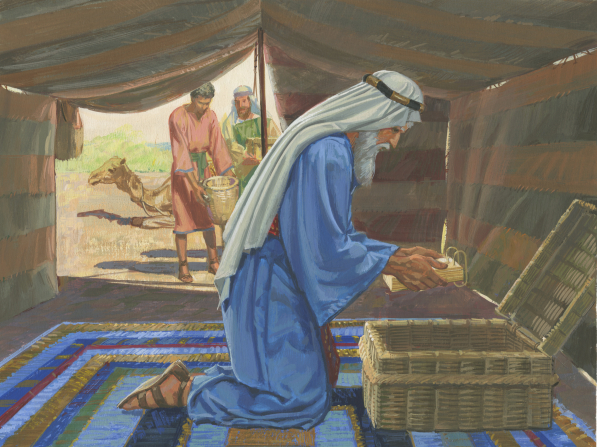
"And it came to pass that he departed into the wilderness. And he left his house, and the land of his inheritance, and his gold, and his silver, and his precious things, and took nothing with him, save it were his family, and provisions, and tents, and departed into the wilderness."

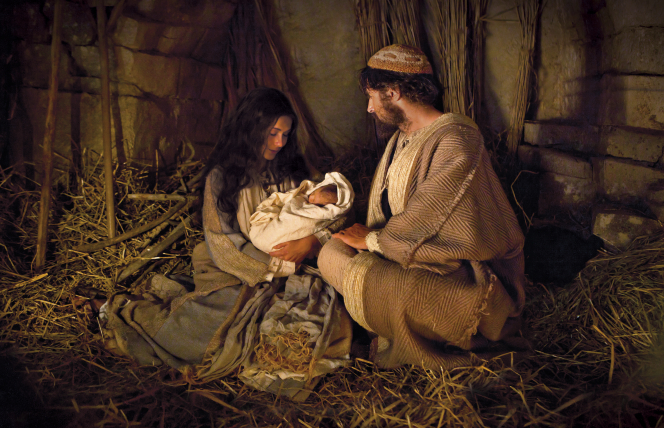
When Christ was born, He left His Father's glorious kingdom to be born in a lowly manger. He condescended and - though a God - was born as a helpless infant. He left royal courts above to sojourn here on earth, similar to how Lehi left all in the Holy City and wandered into the wilderness.


Journey to the Promised Land

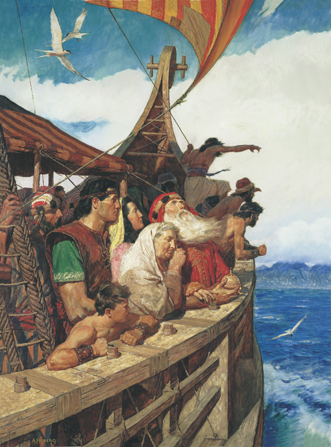
After many years of wandering in the desert, Lehi and his family built a boat and sailed to the Promised Land. As they heeded his prophetic counsel, his family was guided through the trials of a scorched desert and a restless sea, through hunger and heartache, until they arrived in the promised land.


In a similar - yet much greater - way, our Savior left His Home above to be our guide through the heat of the desert and the waves of the sea, that He might guide us to our Promised Land. We will suffer just as Lehi's family did, but we can have the assurance that our guide - Jesus Christ - will support us in every trial as we rely on Him (see Alma 36:3).


A Stumbling Block

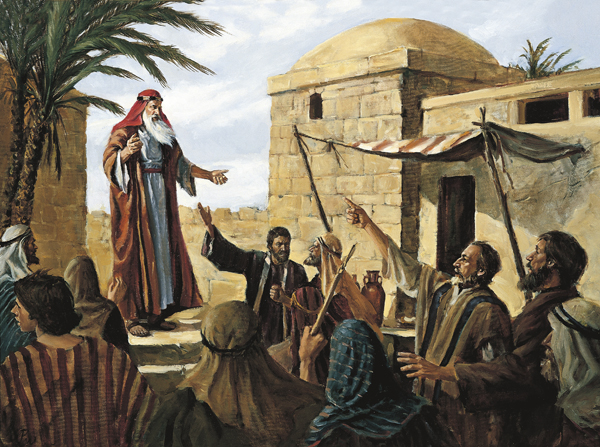
One final parallel that I found between Lehi and Christ is that neither one had a perfectly "loyal" following - even among their very closest associates. Lehi was commanded to flee Jerusalem because the people were angry with him for speaking the words that God delivered to him, and sought to take his life.


His own sons, Laman and Lemuel, constantly complained and questioned his authority and leadership. On more than one occasion they plotted how they might kill their foolish, visionary father and their brother Nephi.

Christ, of course, was betrayed by one of His Apostles. He was rejected by the chief priest and the Sanhedrin in general.


 On the day of His crucifixion, the crowds cried for his death. His own Apostles left Him:
"Behold, the hour cometh, yea, is now come, that ye shall be scattered, every man to his own, and shall leave me alone: and yet I am not alone, because the Father is with me."
After the thousands who were fed in the wilderness turned and "followed Him no more", the Savior asked His chief Apostle, "Will ye also go away?" (see John 6:66-69).
Peter proved faithful in the end, but even he denied the Savior on the eve of His death.


Conclusion

The scriptures truly point us to Christ. I am convinced that one day, the Lord will explain the scriptures to us as He did to the Nephite multitude, and we will be amazed at how many symbols and types of Christ were right before our eyes all along. He is our Savior. I am so grateful that He left all and descended below all things, that He might lift us above all things and guide us safely home to the Promised Land.


These thoughts are my own personal thoughts and do not represent in any way the official position of The Church of Jesus Christ of Latter-Day Saints.

Sunday, January 12, 2014

A Source of Unfailing Strength

In my Sunday church meetings today, the Bishop (the local leader of our congregation) addressed us and announced our ward's (or congregation's) theme for the year of 2014. He spoke of Paul's conversation with the Lord in 2 Corinthians 12 and the "thorn in the flesh" that he asked the Lord to remove, and how the Lord told Paul that His grace was sufficient and His power is made perfect in weakness.

The Bishop shared a Book of Mormon verse in which another servant of God, Moroni, is worried about his weaknesses and fears that his best will not be enough for the task at hand.

The Lord delivers these comforting words to Moroni:

And if men come unto me I will show unto them their weakness. I give unto men weakness that they may be humble; and my grace is sufficient for all men that humble themselves before me; for if they humble themselves before me, and have faith in me, then will I make weak things become strong unto them.

In the words of the Lord to both servants, I was struck by the phrase "my grace is sufficient." I decided to study it in more detail. I visited a website that allows side-by-side comparison of the Greek and English New Testament texts, along with detailed definitions and etymology of the Greek words. I would like to share what I learned.


.............................................................................................................................................
Arkei soi e charis mou

..............................................................................................................................................
'Arkei' generally means to suffice, or to be sufficient or enough. However, it can also mean "to possess unfailing strength."

What possesses this unfailing strength?

'Charis' means grace. Whose grace? 'Charis mou'. "My grace," the Savior tells us.

'Soi e' means "for you" (roughly).


.............................................................................................................................................
"My grace possesses unfailing strength for you."
.............................................................................................................................................


There is nothing that God cannot help us to overcome. If we put our whole trust in Him, we can overcome any Goliath.
Through the unfailing grace of God, our weaknesses - physical, mental, social, spiritual - can be turned into strengths.

Jesus Christ died so that we might live. He suffered all things so that He may lift us above all things.

His grace is sufficient.

I know it.